
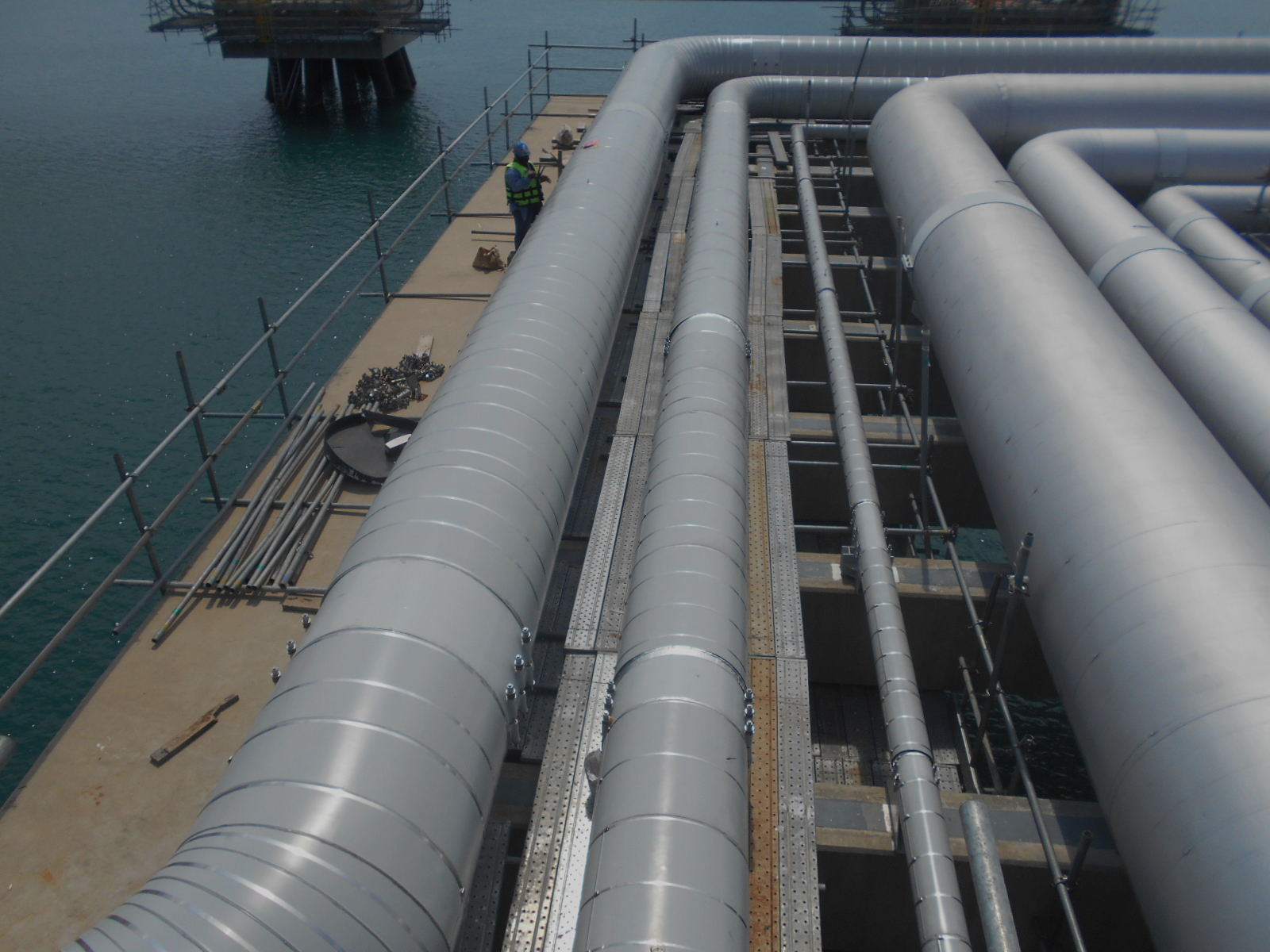
LNG receiving terminal in Thailand.
After unhappy results from cellular-glass insulation on the first phase, the operator specified Cryogel® Z fully across Phase 2 — making it the first regasification plant in the world to be fully insulated by Cryogel®.
Cellular glass had failed badly on the previous phase.
The site’s Phase 1 used cellular glass and ran into recurring icing, thermal-bridging at contraction joints, and heavy CUI.
- Negative experience with cellular glass. Phase 1 problems affected overall process performance.
- Thermal bridges at contraction joints. A structural weakness of any rigid cold-service insulation.
- Heavy CUI and repeated icing. Visible signs of insulation failure in service.
Specify Cryogel® Z across the entire regasification scope.
Cryogel® Z’s flexibility removed the need for complex contraction joints — a traditional weak spot — and enabled live repair during construction.
- No complex contraction joints. Removed a traditional weak spot and simplified installation.
- Process operates as designed. Improved material yield versus the prior cellular-glass benchmark.
- Acoustic and PFP in one product. Added value beyond thermal — fewer specifications to manage.
- Rapid construction, live repair. Mitigated schedule delays without taking the unit offline.
- Specified across follow-on terminals. Operator awarded all cryogenic insulation on subsequent phases.
The quality and performance of Cryogel® Z have proven significantly satisfactory during operation and maintenance.
First fully-Cryogel® regasification plant, then a second.
Phase 2 became the first regasification plant in the world to be fully insulated by Cryogel® Z, with approximately 11M ft² installed across jetty lines, tank interconnects, regasification pipework, and equipment. Based on Phase 2’s results, the operator awarded all cryogenic insulation on the next terminal as well.
Planning a regasification or LNG-receiving terminal?
Aspen can specify Cryogel® Z against your cold-service piping, jetty lines, and tank interconnects.