
Live cold service line at a refinery on the Red Sea coast, KSA.
An 8-inch cold service line insulated with polyisocyanurate (PIR) was icing, cracking, and running surface temperatures as high as 1 °C — evidence of thermal conductivity degradation of up to 1800% outside original specification. 30 mm of Cryogel® Z replaced 60 mm of failed PIR while the line stayed in service.

Degraded PIR turned a cold line into a hidden energy drain.
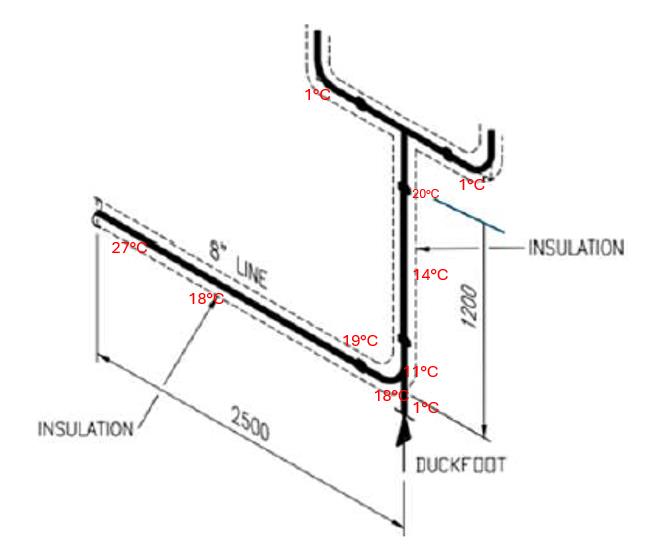
Surface icing, condensation dripping, widespread insulation cracking, and external temperature measurements between 1 °C and 27 °C against an expected 32 °C touch temperature — all signs of a system no longer insulating.
- Thermal conductivity degraded up to 1800%. Field readings taken in April 2025 measured surface temperatures higher than below specification.
- 240.6 W/m of heat gain at the worst points. Calculated with the ASTM C680 tool against actual temperature data — over 2,100 kWh per year per meter.
- $166 per meter per year in electricity. Refrigeration load rose in direct proportion to the heat ingress.
- Condensation and CUI risk. Surface icing and condensation led to cracking and led to corrosion under insulation and pushed up maintenance overhead.
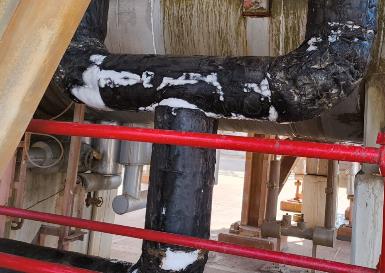
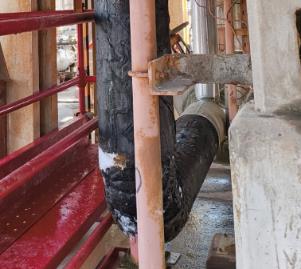
Cryogel® Z installed on a live line, with full operational continuity.
30 mm of Cryogel® Z replaced 60 mm of PIR without a shutdown needed — a first-of-its-kind retrofit executed with no production loss, on a pipe still running at operational temperatures.
- Crews briefed and trained. Cryogel Z® installs quickly and easily, needing minimum training time.
- PIR and frost removed, then pre-cut blanket applied. Cryogel® Z went on as pre-cut sections followed by vapor barriers and protective jacketing.
- Flexibility made speed possible. The blanket format allowed fast, precise fitting under live, low-temperature field conditions — at half the installed thickness.
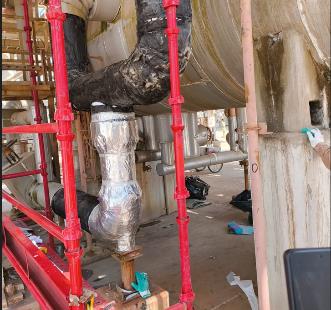
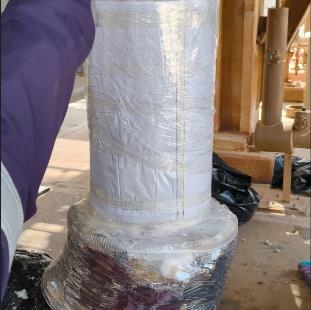
Heat gain cut by an order of magnitude — and the surface came back to spec.
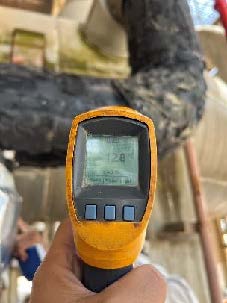
Expected heat gain on the retrofitted line fell to 25.8 W/m, taking annual energy cost from $166 to $18 per meter — an average saving of $148 per meter per year against the degraded PIR it replaced. Surface temperature at the monitored point moved from 12.8 °C before installation to 32.5 °C after, back in line with the 32 °C touch-temperature specification.
The savings figure is conservative: lower surface temperatures were recorded across multiple sections following installation, so system-wide savings may be greater. Beyond the energy number, Cryogel® Z brings proven resistance to moisture and CUI, and is reusable after turnaround events — reducing reinstallation time and material waste from the maintenance plan while reducing refrigeration power demand and CO₂ emissions.


Got a cold service line you can’t shut down?
Cryogel® Z can be retrofitted on a live line at half the thickness of PIR — Aspen engineers can model the heat gain and payback on your scope or specification.